5 things you should NEVER say when someone is sharing their Family Violence experiences

  1. You think you are the only one who has experienced this?
  2. They were doing it to make you stronger, look how good you turned out.
  3. There are two sides to a story – were you provoking them?
  4. But think about your family and what they have been through.
  5. You should try to be sensitive and understanding towards them (abusers) – You are all they have and they have given so much to give you  better life – you should show them more gratitude and respect.

If you have accepted to provide supportive listening and opened up the space for someone to share their lived experiences, it is very important to be mindful about the fact that everyone has unique experiences and trauma impacts each person differently. It is important to believe survivors when they share their experiences and but also remember to ground yourself to the fact that you have not seen or experienced that person’s life at all and so you are in no place to judge it or place yourself higher than them. Here are somethings you should never say to someone who is looking for support and a space to share their experiences of family violence.

1. You think you are the only one who has experienced this?

While sharing experiences in a conversation related to family violence, you may realize that there are many similarities in your collective experiences, however, I kindly advise you to never undermine or invalidate their trauma by saying things like, “You think you are the only one?” or “I experienced worse”.

People often share a small glimpse of their lived trauma, making judgmental or snarky comments like these may push survivors to be defensive and dive deeper into revealing details of their experience which can be very triggering and may offset their healing process, sometimes even triggering serious mental health issues like panic attacks, disassociation and severe depression which they may already be trying to cope with.

Everyone has unique capacities of coping with trauma. The same experience can crush one person and have little effect on another. Each of those capacities should be respected and their method to heal and move forward validated.

2. They were doing it to make you stronger, look how good you turned out.

Well this may seem like a well-meaning comment but it sounds like you are justifying the abuse faced by the person. It suggests that they should be grateful for the trauma and ignore the damage caused (many survivors would like to ignore the damages but trauma is invasive and the destructive impact can only be dealt with through mindful intervention).

By having such a thought process you are turning a blind eye to the person’s traumas and all the efforts they are putting in coping with the impacts of their lived experience.

3. There are two sides to a story – were you provoking them?

There can be two sides to a story but at the moment when someone is trying to share the hurt and pain they experienced, the hurt can be amplified when questions of disbelief are thrown at the person. People deserve to have space to share their experiences to process. If you as a listener are unable to have a productive supportive conversation, it is very important to step away politely. Stepping away politely can be more powerful and serves as an act of kindness than invalidating the survivor’s experiences.

4. But think about your family and what they have been through.

Often times toxic traits within family come from a history of unresolved mental health and social issues, for example, survival of man-made and natural disasters, wars, and harmful traditions. Lack of resources to heal from these issues and denial to seek help are few of the main reasons why family violence still exists, harming so many individuals and the community as a whole.

Survivors of family violence know the circumstances of their family. A lot of them already know that the toxic traits are learned behaviors that abusers are not willing to change. Often times, they may have even reflected on it and justified the abuse themselves. When someone shares their experience, they are speaking of their own thoughts and feelings. They are navigating their healing process by sharing stories. They are learning to set boundaries for their own safety and well-being and for the people involved. They are processing their life and the impacts of trauma at their own pace.

5. You should try to be sensitive and understanding towards them (abusers) – You are all they have and they have given so much to give you  better life – you should show them more gratitude and respect.

Questioning them to think about family history and background can be very invalidating to the person’s lived experiences; it can be very accusing and damaging to the person’s healing process and may induce feelings of distress, guilt and self-hatred in the person. Let people share their lived experiences without any judgement – if you feel like you are not in the right headspace to listen without judgements or the topic of conversation is not something you want to engage in, it is absolutely okay to step away and you have every right to politely let the person know that you are unable to have this conversation.

Freezing, unsung instinct of survival

Today I want to share a few thoughts about a natural response of our body that receives a lot of stigma – Freezing during a distressful situation. People who have experienced freezing in violent situations are often shamed for their reaction. A survivor’s freezing reaction is wrongfully used to blame the survivor. In many cases, this involuntary reaction to danger has shamelessly been used as a tool to disregard or even deny justice and support for the survivor.

There are many misconceptions associated with the freezing reaction while in a distressful situation. As a survivor, I have for the longest time been devoured by these misconceptions and ruminated for years and years if I was weak because my mind and body shut down when I was in a situation where my safety and well-being was at risk. Too many times, I have gotten stuck in my ability to validate my experiences, often spiralling into a dungeon of self-doubt and self-hatred, just because I couldn’t understand why I was not able to take the right action.

I needed to find answers. I needed to understand why I shut down in times where I needed to use my mind and body the most. Where were my flight-or-fight responses? I needed to know. So I started looking into it. I hope you will embrace the information I have shared below and I hope it brings you peace and connection.

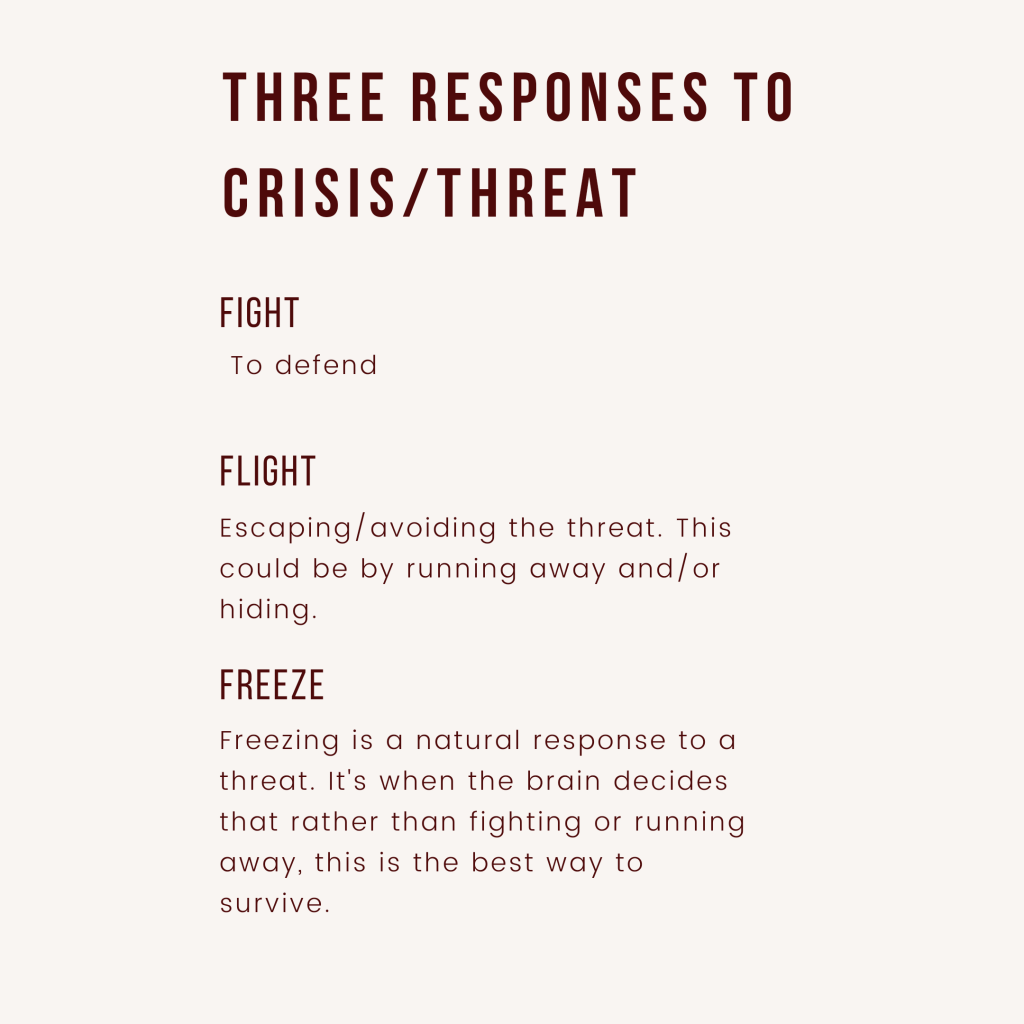
I have always thought that our body has two responses to a crisis or a threat, either you run away or you fight.

However, in many family violence and domestic violence situations, the brain of the person experiencing the abuse may assess the situation and realize that either of those responses could be detrimental to their well-being. That’s when the third reaction kicks in -Freeze for action in response to a threat.

When experiencing or witnessing abuse, it is normal and absolutely valid to not know what to do and feel stuck.

The questions often arises, “Is my flight-or-fight response broken?”, “Am I unable to handle such situations?”, “Am I weak?”.

Now I understand that freezing in a crisis is an automatic involuntary response to a threat. It is when our brain assesses the situation and decides that the best course of action for this threat/crisis is nothing. Basically, our brain understands and tells us to not react externally and to wait until this threat has passed.

This reaction of feeling stuck- this seemingly abrupt shutting down of mind and body to violent threats often brings in feelings of guilt and anger in oneself during later reflection after the danger has passed. I myself have often wondered and self-deprecated for not running away, for not raising my voice while witnessing or experiencing violence in my home. I have always thought I should have known better and done better. I often am riddled with thoughts and feelings of guilt and feelings of incompetence for not taking more rigorous steps in standing up against violence or protecting the other members of my family experiencing abuse.

It’s tough, but it’s an active effort to pull myself out of those strong whirlpools of anxiety-ridden thoughts of de-valuing myself. I am learning to accept and validate my experiences. I now think of freezing in the way it is observed in the wild. When an animal senses a potential threat, they freeze. Their stillness merges with their environment. They become still as the tree branch they are on or still like the rock they may be sitting on. They become one with nature in the hope of survival. As if their brain is advising them, “if you don’t react you won’t be seen and the threat will pass without harming”.

In some branch of evolution, this trait might have passed on to our brain. I always thought of freezing as a weakness but now understand it’s an important coping strategy developed by the brain to keep you safe and ensure your well-being for the present and for the future.

I hope you, my dear reader, will validate and empower your mind and body’s coping. You are not broken because you froze during a distressful situation, you are wiser, stronger and more resilient than ever because you did.

5 things you should NEVER say when someone is sharing their FV experience

CONTENT WARNING: Family violence, Trauma

When someone is sharing their lived experiences of family violence or any distressing experience, it is very important to be mindful about the fact that everyone has unique experiences and that trauma impacts each person differently. It is important to believe survivors when they share their experiences but also remember to ground yourself to the fact that you have not seen or experienced that person’s life at all and so you are in no place to judge it or place yourself in a position of power to dictate to them what they should do and how they should feel.

I would also like to emphasize beforehand that if you are in a situation where the topic of conversation is something you are uncomfortable talking about at that time and space, communicate that to the person politely and guide the conversation another way. I will provide more guidance about expressing your discomfort to someone who may want to talk about a topic you are uncomfortable about in later blogs. Today, I want to share a few things you should never ever say to someone who is sharing their lived experience with you if you have proactively engaged in having this conversation.

1. You think you are the only one who has experienced this?

While sharing family violence experiences, you may realize that there are many similarities in your collective experience, however, never undermine or invalidate their trauma by saying things like, ” You think you are the only one?”. People often share a small glimpse of their lived trauma, making judgmental or snarky comments may push survivors to be defensive and dive deeper into revealing details of their experience which can be very triggering and may offset their healing process, sometimes even triggering serious mental health issues like panic attacks, disassociation and severe depression which they may already be coping with.

2. They were doing it to make you stronger, look how good you turned out.

Well this may seem like a well-meaning comment but by saying this you are justifying the abuse faced by the person. It suggests that they should be grateful for the trauma and simply ignore the damage caused – something the person may already be fighting to deal with everyday. By having such a thought process you are turning a blind eye to the person’s traumas and all the efforts they are putting in coping with the impacts of their lived experience.

3. There are two sides to a story – were you provoking them?

4. But think about your family and what they have been through.

5. You should try to be sensitive and understanding towards them (abusers) – You are all they have and they have given so much to give you better life – you should show them more gratitude and respect.

The next three things that I would advice never to say have a similar theme: Sympathizing with the abuser. Often times toxic traits within family come from a history of unresolved mental health and social issues, survival of man-made and natural disasters and wars, and traditions. Lack of resources to heal from these issues and denial to seek help are few of the main reasons why family violence still exists, harming so many individuals and the community as a whole.

Survivors of family violence know that the circumstances of their family. A lot of them already know that the toxic traits are learned behaviors that abusers are not willing to change. Often times, they may have even reflected on it and justified the abuse themselves.

When someone shares their experience, they are speaking of their own thoughts and feelings. They are navigating their healing process by sharing stories. They are learning to set boundaries for their own safety and well-being and for the people involved. They are processing their life and the impacts of trauma at their own pace. Questioning them to think about family history and background can be very invalidating to the person’s lived experiences; it can be very accusing and damaging to the person’s healing process and may induce feelings of distress, guilt and self-hatred in the person.

Let people share their lived experiences without any judgement – if you feel like you are not in the right headspace to listen without any judgements or this topic is not something you want to engage in, it is absolutely okay and you have every right to politely let the person know that you are unable to have this conversation. If you want to help the person – be a supportive listener, be genuine in wanting to hear their story and helping them cope with their trauma. Gestures of kindness and care can go a long way.

Honour, an excuse to commit Gender-based abuse

Honour is just a concept created by the patriarchs to ensure their dominance and control over women. Honour is a fear tactic to keep women in their place – where they are powerless and oppressed. Anyone who dares to speak against is immediately restrained and shamed. If the survivors continue their struggle, they are abused to the point that they submit infinitely or they are murdered. Please watch this video where Jasvinder Sanghera shares her struggle and the struggle of those trapped in this evil oppressive trap of the “Honour system”.

The sad thing is the people doing this to you are the ones who are meant to love you the most.

-Jasvinder Sanghera

Jasvinder Sanghera shares her story of escaping child marriage. She speaks of her protests against the marriage when she was 14 years of age and the harmful consequences of her protests. Fortunately, she manages to run away and escape from her abusers. She was disowned as she had dishonoured the family and she was left to fend for her own. An important part of her escape was the help she received from the police officer who found her when she had run away. She pleaded him to not send her back to her family. He listened to this run-away teenager and helped her by not talking her back to her family.

She compares her story to that of two victims of honour-based killing: Raveena, her older sister and Shafilea Ahmed.

“There were certain things we were not allowed to do as normal adolescents growing up… we were not allowed to go to the school disco; we were not allowed to talk to a boy. Because all these things were deemed right and proper and honourable.

If we breached any of those codes – these conditioning because were learnt to do this through our behaviour, and we were ruled by fear.

These were the rules of engagement, and if we breached them we put ourselves at risk.

It could be a trigger for significant harm, physical abuse, forced marriage and we know today, even murder.”

-Jasvinder Sanghera

Raveena was two years older than Jasvinder. When she was in high school, her education was stopped and she was sent to Pakistan to get married to a stranger of her parent’s choice. Her marriage was terrible; she was abused physically and psychologically. She didn’t want to leave the marriage because she was committed to her duty of upholding the honour of her family. She sought help from the elders of her community. They advised mediation with the perpetrators. She was forced to go back to her hostile family without any real help. She committed suicide.

Shafilea Ahmed was a young girl with dreams and ambition which were seen as being too “Westernized” by her family. She tried to run away multiple times, seeking help from various non-profits. Sadly, her pleads to save her from family went unheard. She was taken back to her family to mediate their differences. It can only be assumed that her family put on a face convincing enough to show that they cared for their daughter and that she was safe in their hands. They murdered her.

“My mother and the females of the family are the key perpetrators – I am ashamed to say that women do uphold these honour systems and are the gatekeepers to this abuse.”

-Jasvinder Sanghera

To this day, women continue to live in fear in their own homes, conducting themselves to the set rules that uphold honour of their family and culture, even if it is against their own will and even if it means they have to put up with hostile and toxic relationships. Speaking out is deemed dishonourable and is usually retaliated against by physical and psychological harm. Seeking help from “wise” elders of the community results in mediation with perpetrators and the women are forced back into their hostile environments, often times leading to suicide or murder.

This is a sad reality of so many women in the world whether they reside in a developed country or a developing country. Be mindful of the attitudes and beliefs of people, take the lead in initiating difficult conversations about violence and abuse, and create a supportive environment to promote survivors to seek help without fear.

Remember mediation with perpetrators does not always mean things will be alright.

DOMESTIC VIOLENCE AWARENESS

October is a special month dedicated to an important cause to save the lives and sanity of many people, and stand for all those who have been victims of domestic violence.

This month is for those who suffered violence from those who are supposed to love and care for them. This is the month for those who have lost their childhood too early in their lives because of the violence they had to witness, suffer and survive through.

This is a just another month in the year to let survivors know that they are not alone, to let them know they are strong, to let them know that it is okay to be afraid and it’s okay to want to get out and feel safe and there is a way out.

Self-reflection

Patience is indeed a virtue that has brought forth wonderful gifts in the form of experienced knowledge and challenges to apply that knowledge and grow

The last couple of days for me has been very self-reflective. I had a couple of episodes where I lost myself completely-I felt like I dived in head first into a whirlpool of hopelessness, unhappiness and numbness. I felt like letting go and that giving up was the only option. Fortunately, I have wonderful support and I was made aware every moment that I wasn’t alone and that my struggle is worth living for.

Upon calming down, I realized that I have so much to be grateful for. I am so lucky. I am one of those that got away for good and I want to use this good to help those who need it and help prevent harm to people with all the energy I have.

This new awakening in me opened my eyes and mind to realize that there is no good coming from self-pitying – wishing I didn’t have these memories that plunge me in a black hole of misery. I am trying to accept it. It happened. I realize that patience is indeed a virtue that has brought forth wonderful gifts in the form of experienced knowledge and challenges to apply that knowledge and grow. I have to move on. I have to step forward instead of sit in the same place wondering how different my life and my mental health would have been had I not had lived experiences of abuse and assault.

I have been thinking a lot more of those strong people who are still living those experiences. I want to help them. I want them to know that they deserve better and I want them to get it.

These self-reflection has driven me to research more, to keep learning and understand. A few days before my breakdowns, I had read a quarter of the way of Samra Zafar’s “A Good Wife”. The patterns of behaviour and conversations she had lived through revived memories of my own lived experience. Each time I had flashback of memories because of her life story I felt like I was being stabbed in my heart and hammered on my head. I thought someone had written my story, my mother’s story. I felt hopeless and hurt about my life and put the book away.

It took me a few weeks after to pick the book up, I puckered up the courage to read Samra Zafar’s life till the end. I needed to know how she survived. I needed to feel like I am not alone – that people like mother are not alone. I read the book within a day and felt a new sense of enlightenment and glow of hope. Samra Zafar’s patience and dedication to her education and self-growth seeded in me a new mission. I immediately rested the book on my coffee table and started looking up research on family violence and sexual assault in my laptop. I am learning and understanding critically. I know within these lived stories and within these diligent research done by experts, there is an answer. There is a way that will help bring an end to violence and assault completely. There will be a world where no being in the world will suffer silently. There will be peace and understanding, and endless love and open-mindedness. A world where negativity will be mitigated through integrity, open communication, affirmation and positive changes.

There is a world like this. It is somewhere in the future, it just needs some hard-work and dedication to get there. I am on it right now.

Journey of Recovery: The Power of Distance, Independence, and Technology in Abusive, Guilt-Tripping Relationships

Till I was 21 years old, I thought it was okay to be a punching bag.

HOW TECHNOLOGY BECAME MY POWER TOOL IN MY ABUSIVE RELATIONSHIP WITH MY FATHER:

Today, I am embracing my empowerment and independence from the abusive relationship I have been for 23 years. Till I was 21 years old, I thought it was okay to be a punching bag. After all, my father has always ensured that I had food to eat, I had books and stationery to study with, and I had a roof over my head; he has also spent a lot of money for my education. He never ever failed to remind me and my family of these facts and he does so to date when I remind him that I am a human and would like to be treated with respect and not be abused or manipulated.

Don’t get me wrong, he has always asked me, his only daughter, to reach for the stars and be educated and he always said he would help me reach it. I will indefinitely be grateful for his progressive thoughts and his progressive actions. However, as I grew older and lived far away from him, I realized that his intentions for my success was more of a modern and progressive trap for me to forever be his puppet and his worshiper, I found being educated with his help less appealing. I knew I needed to free myself from the cage I had built in my head that was accepting of my father’s manipulations – I needed to empower who I was within and follow my passions rather than this person I was becoming who wanted to please my father so that my mother, my brothers, and I could be safe and sane.I don’t know if I would have ever thought about empowering myself from within, to become strong enough to say, “No, that’s enough. I will no longer be taking your abuse and your manipulations”, if I was still living at my parent’s home. I am still not sure if I could be strong if my father and I were face to face – I know there is still a side of me that will cower and fall back into the dark cycle of oppression thinking that the abusive treatment is exactly what I deserve because of having a voice and using it. But now, with thousands of miles of distance between us, and thanks to technology, I feel more free and empowered than I have ever felt before.

I never really could document what my father did to me except in words, after things had cooled down. And even the words I used had to be masked with metaphors to hide the shame.

If you are wondering how did technology help me. Well, when I used to live with my father and I was being maltreated, kicked, slapped, and dragged inhumanely, I never really could document what my father did to me except in words, after things had cooled down. And even the words I used had to be masked with metaphors to hide the shame. I never really talked about it with anyone because I was embarrassed of what I went through and I was scared no one was going to believe me and they would tell my father that I was being an ungrateful child, which has happened before.

Fast forward to being thousands of miles away, my father still found a way to torture me – using technology. When I couldn’t pick up his calls late at night, he would send me lines and lines of texts calling my mother whatever derogatory word he could think of, he would emotionally abuse and gas-light me via texts. It would be messy, hopeless and hurtful. It would trigger in me the memories of my childhood when I was beaten black and blue, when I was stomped on the face, and of all those times I was certain I was going to be stabbed to death by my own father. I would be mentally devastated and unable to function at school and in life.

There would be times I would ignore the messages and there would be times I wrote back. The first time I empowered myself and texted my dad that all his abuse was being recorded was the most enlightening and eye-opening moment in my life. Immediately, there was a change in his tone of texts. It shifted from being hurtful to a tone where I felt a sense of fear in his texts. He started texting things like: “Record and put it in my grave”, “When I will die you will remember and cry”, “I pray for you but Allah will accept it or not, I have doubts”, ” I don’t know what mistake I do”. You get the idea – he starts writing texts where it sounds like he is the one suffering and he brings religion into it, saying that he is hurt but will still pray for me but God will not listen because I am a bad person, little does he know that trying to bring the good light and pity on himself he was still being manipulative.

Suddenly, I realized that I had a tool to protect myself and stop my father from escalating his anger and manipulative ways. Anytime, my father would call me and start verbally and emotionally abusing me, I would casually say that he is being recorded and he would completely change is tone, tell me that I will suffer when he is gone and then cut the call. I never felt that kind of happiness before. But I also realized how technology is super underrated and underdeveloped in dealing with domestic violence situations. Maybe if we had the proper technological tools, then we could subtly save evidences of abuse without the abusers knowledge in their presence; victims of domestic violence wouldn’t have to fear being caught recording evidences like I did when I used to live with my father.

It takes a lot of effort to actually pucker up the courage and start recording evidences- for me, distance made it easier to start thinking about how I could protect myself, not just to remind myself that my father is abusive and I shouldn’t give in and let my guard down when he acts like the kindest man on earth, but also if things were ever to escalate I will have something to show and go by the legal route.

HOW DISTANCE EMPOWERED ME TO NOT FALL BACK AND TO SPEAK UP IN MY ABUSIVE RELATIONSHIP WITH MY FATHER:

As a child up until my 21st birthday, I used to think that since my father has done so many things for me to make sure I am alive, I should respect how he treats me, how he treats my mother and my brothers. I knew he just wanted us to be his grateful, obedient, and most compliant servants who never argued to anything he said or yelled, who took his beatings and his outbursts like a proper servant should. After all, he is the reason we weren’t on the streets begging for food, or being man-handled or enslaved by other people, as he always reminded us graciously.

Back when I used to live in his house, anytime he had a bad day, he was angry with anything, or anytime we did something he didn’t like, he beat us, he publicly humiliated us, he called us names, he told us how we were nothing without him, and how he could throw us to the street whenever he wanted and people would treat us like slaves and they would do very bad things to us, he told us he was our God and he could do anything he wanted to do to us, and how he could kill us and nobody would care because we were nothing. He reminded us in every way how he had power over us and that we were helpless and powerless.

Sometimes, I would forget my place as a servant and I would fight back whenever I couldn’t take it anymore. I would tell him to stop beating us or try to physically defend myself by pushing him off. I would argue back and ask him to not shout and to talk sensibly to us. I would tell him, “we are not afraid of you”. He didn’t like that, obviously. Every time I did these things to defend and protect myself and my family, I knew I was just adding fire to the fuel. I knew things would only go to the worst from there. But there was only so much torture I could take quietly. It always escalated his anger. I would only stop defending myself and my family when I was begging for my life thinking that he was going to kill me.

I don’t remember what exactly would slow him down and stop his one man war against us. He could go on for hours and hours whether I fought back or not. Every time, I would just cry myself to sleep. That was the only escape when he would slash our ear buds with his sharp words. It was a good day if he didn’t attack us physically or do something worse like tear my books.

He would calm down the next day or so and find ways to reconcile by saying he only gets angry because he loves us and cares about us. I would remind him of some hurtful things he had said to which he would say, “don’t make me angry then, you know how good men get angry very fast” and then relate to some great leader like Stalin or Putin, or he would deny he ever said anything bad. He would remind us about how he is a good man and he is different from other fathers. He would tell us that he would do anything for us and he does more than any father ever does for their children. He would say and he still says that we would realize how good of a man he is when he is dead, which he constantly reminds us could be any day. He says that we would miss him and realize we shouldn’t have fought or disrespected him when he is dead. He would make us feel guilty until gave in and told that we were sorry and that it was our fault.

I would instantly fall for his manipulations when I lived with him. He is my father. I don’t want him dead and yet there would be times I would fantasize a life without him or even, you know – wish he was dead so that we didn’t have to live in torture. When he would calm down, he would act so nice and kind, I would forget that he ever did anything out of place and tell myself that I probably deserved the inhumane treatment because my father only does things because he cares for us. I would go back to, not being his daughter but, being his servant. He loved it when we treated him like God and I would do as much as I could to please him and pray he didn’t get angry again.

Now, as an adult living away from my father, I am grateful for the distance. I am grateful that he sent me abroad to study. Little did he know that it was his own befalling. Now as I confront his abusiveness and request him to seek therapy, he tells me how I have changed, and I have become disrespectful and disobedient and maybe it was his mistake to send me abroad. He still calls me late at night to tell me hurtful things and to use me as his punching bag for his unresolved anger problems. I don’t know what would trigger these thoughts in him and want to give me these late night verbal slaps and punches. We are literally an ocean away and I still had to be aware of my next attack.

I feel guilty sometimes, wondering if he had not send me away to study would I have been as I am now. Would I have continued sucking up to him so that he wouldn’t lose his mind and drown us in his miserable and destructive temper? Would I still been that little girl who accepted every black eye and green bruises thinking it was to make her a better person? I am trying to be happy to know that my father’s mistake led to my triumph. It is difficult to not feel guilty and make deals with the devil. It is very difficult to stand up for myself and minutes later feel like I am doing something wrong and that I am terrible daughter. Sometimes, it is so very difficult to pull myself from the whirlpool of PTSD and hopelessness. But I grow stronger every time I push through those mentally exhausting times and rejoice my independence, my empowerment through distance, and my freedom from the domestic violence.

Needless to say, throughout my life at my parent’s place, I always lived in fear and anxiety, awaiting another explosive outburst from him. Life at that place was very unpredictable. My mother, my brothers and I were constantly trying to read my father’s mood, trying to be invisible unless called upon. Looking back, our cautious and strategic behaviour never really helped. He would find ways to torture us and show us that he had power over us. He was so afraid to lose power over me, he never let me hang out with friends outside of school. If I had a favourite teacher, he would always get angry and say things like “Go fuck/marry your teacher”, “Your teacher doesn’t know anything, I can teach all that easily and better”, “I was an excellent student, only poor student become teachers”. If I had a close friend, he would tell me that he was the only one in the world I should trust, that he was my only best friend. He told me not to have friends. He told me if anyone tried to be friends with me, it would be to use me because my father was rich. He would tell me, “Jari, you are not very good looking, you should study hard to succeed in life. No one will be your real friend, only I am your real friend. Don’t trust anybody. Because you are not so good looking, people will only try to be friends with you to use you.”

For the most part, I used to believe him and developed trust issues. But he couldn’t keep me from making friends. I had some amazing friends in school. School was my solace. I just tried my best not to talk about my friends or role models to my father after I realized it would trigger a bomb in him. Any time I did out of excitement or by accident, he would lose his mind. He would yell for hours and hours at me saying things like, “Go ask your friends for food then”, “They only like you because your father has money”. He just didn’t do it when I was in school but even when I was in University. He would constantly remind me that he wasn’t paying for my education to make friends.

It was honestly just fucked up. He made me feel so bad about myself. My self-esteem and confidence was very low. I was very suicidal both in school and in university. The only things that kept me going was that I needed to protect my brothers from this monstrosity, that I knew I had amazing friends whom I loved, and that I wanted to make a difference in this world. Now that I think about it, I realize that his fear of losing his influence and power on me was so high, he was jealous of my friends, role models and teachers. He tried every thing to have me not have friends. And he was successful in keeping me imprisoned at home after school. But in school, he was powerless.

HOW EDUCATION AND INDEPENDENCE SAVED ME:

My father would always tell me that education was everything. He would say that he had a very difficult life getting education so he wanted to make sure we had a good one. I am very grateful for my father for this. However, my father wanted to provide us with education so that we would be forever indebted to him. He would talk highly of educated people but my father has also torn my books and thrown my bag in the garbage if I ever talked highly of any teacher or if I tried to debate his ideas. He would say that he wasn’t sending me to school to fall in love with teachers. Once he almost burnt my books, because I questioned his beliefs he was thrusting upon me. I remember him screaming, “I know everything. You know nothing. I know more than your teachers and these books. You have become so brave thinking you know everything because I send you to school. You are nothing without me”. So many times he would threaten me that he would stop my schooling until I begged and cried to him to let me. Once when I went back to visit from University, he almost tore my passport because I told him to not yell at my mother so I couldn’t go back to university. My mother and I had to beg and say that we were sorry and were at fault till he gave me my passport back. He really enjoyed that. He still wants me to beg him for forgiveness when I tell him to not yell at me via phone or text. Just I can respond differently now that I am far away.

His hypocrisy baffled me then and amuses me now. As I mentioned earlier, my father believes that he made a mistake sending me abroad to study. He thought I would be forever indebted to him because he did something that no other muslim father would do, that is, send his daughter abroad to study. He would constantly remind me that he was different and no one would ever send me abroad. He was giving me the best education. I will forever be grateful to him for this.

Unfortunately for him, he handed me powers that would fight against him. He thought I would forever suck up to him. Treat him like God because of this. I do respect him but I have learnt here that how I lived was not normal; What I went through was not normal.

My first two years of university, I used to believe that I had to do it. As the oldest child, I just had to deal with this aggression and I was supposed to be understanding. I used to think that I was strong because I could take this abuse and maybe this was my purpose, I had to be strong and handle my father. I tried to never confront him and quietly take the verbal beating. I kept guilt-tripping myself and my father also helped in keeping the guilt in me that I owed my mental health to him for beating as he has done so much for us.

University, however, was a huge change for me. I went from being anxious all the time because a threat was actually around to being anxious all the time when no threat was around and not knowing what was scaring me all the time. I was confused and unable to focus in studying. I was constantly looking for distractions. I was amazed and joyful at all the love I was getting from my new friends and my student leaders. The world was so wonderful around me that I kept seeking this joy that I never felt before. I wasn’t imprisoned anymore. I could go anywhere I wanted after school; I could explore the world around me fearlessly and learn things that I was kept away from. Needless to say, I didn’t do well in school. This gave my father just more reason to yell at me and make me feel less than I was. I became very anxious and very suicidal. I didn’t really know about mental health well back then or the importance of talking about it and seeking help. I learnt a lot about it when I was training for a leadership position.

In my third year, I truly started questioning the acts of my father. I started deciphering what he did to us. I had never pieced it together that we were in a domestic violence situation until I started learning more about mental health. I started really speaking up. I used to tell my father that he had anger management issues and that he needed help. I tried to understand where all the anger was coming from. I tried to reason with his terrible acts.

He never listened. He only talked back at me and I tried to be an active listener and support him. In my third year, I found out that my father started using online sex chats. He is poor with technology and didn’t hide his footprints well. My mom found out too and confronted him. And obviously, he lost his mind. He would call me and send me lines and lines of texts saying terrible things about my mother. I finally confronted him. I told him I knew what he was doing and he should stop attacking my mother. I told him that what he was doing is domestic violence and he was violating our rights. It was a terrible battle where I lost and won at the same time. He stopped talking to me and my family for a bit. But suddenly, as an international student, I was left with no financial help.

The tuition and the living cost as an international student is huge. I was close to being homeless. I was mentally devastated, depressed and anxious. I wasn’t eating so that I could save money. I had lost my job. I really thought ending it all would be just fucking great and awesome.

My greatest strength has always been that I don’t give up easily. It is one of the reason I am still alive. I knew that until I graduated I had to be sensible. I just really had to push through, graduate and be independent from him. I luckily found a job. My father was kind enough to pay for my tuition. I made sure that all my other expenses was all on me. I worked throughout my school year. I worked on my mental health piecing together why I felt the way I did and the ways I should deal with it. I really couldn’t afford the time to commit to a therapist because of work and school but the few sessions I did go to I tried very hard. I found the foundation to help myself. I wanted to really help people like me and that’s when I decided to change my major to Psychology.

Honestly, I don’t know if I would ever have managed to heal myself had I decided to cling on to the relationship with my father. Realizing that I had to be independent from him opened my eyes. It motivated me to work hard and stay focused. It took a while but eventually I did. It even showed up in my GPA, nothing stellar but some improvement. I worked on myself and less on needing to deal with my father’s emotions.

3 hard years later, I graduated. The day I received my certificate. I was relieved. From now on, I am free. I knew this was my sword, this was my key, I felt endless and powerful. Soon after I graduated my father sent me a lines of texts trying to guilt-trip me, tell me how I was nothing, and all I replied was, “Okay”.

That was the most powerful moment for me. I realized I could ignore all his abusive words. I no longer belonged to him. He had no power over me. Anytime he would text me or call me to talk down on me, harass me, I told him that I didn’t have to take his emotional abuse and that I was recording him. He obviously tried to guilt me by saying that he would die soon and I would be crying for him or that he shouldn’t have been sent to Canada but he doesn’t go on and on when I tell him that he is being recorded. I feel saved with my education and independence. Now, I hope to save my mother and my brothers still stuck in that vicious web built by father.

The power of distance, independence, and technology has given me a new chapter in life. A chapter where I am in charge. I want to bring it to people who need it.
Understanding the Past, Overcoming the Present, Liberating the Future

PAST: Living at my parents home, everything seemed normal. Looking back now, I realize how a lot of things I carried with me might have been normal on the outside, but the context within was not.

Bruises are normal. Being sore is normal. Swollen, reddened eyes are normal. Being aware and very cautious of your surroundings is normal. Being scared is normal. Being angry is also normal. Finding excuses to hide away the shame you carry is normal. Lying is normal. Trying to survive everyday is normal. Right?

From the time I could remember to my teenage days to when I left home, I thought I had it easy. And I did to a great extent. I always had food on the table. I always had the stationery I needed for school. Sometimes, there would be lots of fun and laughter like everything was okay and things were getting better. But mostly, my mind would be racing with thoughts like: “Why can’t I go out with my friends? What excuse should I say to my classmates when they see this bruise? Fuck, how do I make my eyes look like I haven’t been crying all night? I don’t know how I am going to concentrate in school, they were fighting all night. I wish I didn’t have to go home. I wish I could run away. I hate that I have to see the person who beat me black and blue and verbally abuses me everyday. I can’t get the picture of them threatening me with a knife off my mind. I can’t stop thinking about the times I felt that it was my last day on earth while my head was being banged against the wall. I wish I didn’t have these flashbacks. Maybe they are right, no one is ever going to love me or care for me, I should stick with them. Maybe, I was born to be treated this way. I have to protect my brothers and fight for them.”

PRESENT: I am glad I don’t live in that environment anymore. I still have some of those thoughts and flashbacks that put me in state of anxiety, then panic, then roller coaster straight down to hell where I forget that I am more than a victim or a punching bag. There are days I feel empty and numb, wondering if being a punching bag was my true purpose, wondering if that would help me feel again. Everyday, I am learning to fight those thoughts and feelings healthily. It was only a few years ago, I realized that I would rather be poor than go back to that environment and depend on them. I was very broke and I was close to being kicked out of my house, and going hungry to not go over my credit card limit. But I was happy. Albeit I was ashamed to talk about my situation which lingered in my mind all the time, whether I was with my friends or alone. I was happy and felt empowered to not have to depend on them. It took me a while to not be afraid to be loved because I associated being loved with being harmed, as a threat to being alive, and being enslaved. In University, I started meeting new people, made amazing friends, and learnt that I could be loved just for being who I was and not because I was an object for someone else’s benefit, as I was told growing up. I found mentors that guided me in a healthy way, who made way for amazing opportunities for me to grow. I will forever be grateful for their guidance. I learnt what it means to be genuinely forgiven for mistakes, being part of a team, being appreciated, and just being another human. I started growing and changing positively through all the constructive feedback I was getting from the community around me. I became someone I never thought I would become. I fell in love with myself, my friends, and with my community. Everyday, I feel more and more human.

FUTURE: I don’t know what the future holds but I sure know that it will be challenging. Presently, I am trying to understand the past and positively heal so that in the future I can continue to connect and give back the love and compassion that the community has so generously given to me. Even though I have broken a lot of the chains that held me back, there are some that I am in the processing of breaking. I am not worried because I know that in my future, I will be free.

Design a site like this with WordPress.com
Get started